A PHP Error was encountered
Severity: Warning
Message: Undefined array key 0
Filename: views/newspaper.php
Line Number: 25
Backtrace:
File: /home1/checkam/news.checkam.info/application/views/newspaper.php
Line: 25
Function: _error_handler
File: /home1/checkam/news.checkam.info/application/controllers/Newspaper.php
Line: 614
Function: view
File: /home1/checkam/news.checkam.info/index.php
Line: 315
Function: require_once
A PHP Error was encountered
Severity: Warning
Message: Attempt to read property "name" on null
Filename: views/newspaper.php
Line Number: 25
Backtrace:
File: /home1/checkam/news.checkam.info/application/views/newspaper.php
Line: 25
Function: _error_handler
File: /home1/checkam/news.checkam.info/application/controllers/Newspaper.php
Line: 614
Function: view
File: /home1/checkam/news.checkam.info/index.php
Line: 315
Function: require_once
A PHP Error was encountered
Severity: Warning
Message: Undefined array key 0
Filename: views/newspaper.php
Line Number: 25
Backtrace:
File: /home1/checkam/news.checkam.info/application/views/newspaper.php
Line: 25
Function: _error_handler
File: /home1/checkam/news.checkam.info/application/controllers/Newspaper.php
Line: 614
Function: view
File: /home1/checkam/news.checkam.info/index.php
Line: 315
Function: require_once
A PHP Error was encountered
Severity: Warning
Message: Attempt to read property "name" on null
Filename: views/newspaper.php
Line Number: 25
Backtrace:
File: /home1/checkam/news.checkam.info/application/views/newspaper.php
Line: 25
Function: _error_handler
File: /home1/checkam/news.checkam.info/application/controllers/Newspaper.php
Line: 614
Function: view
File: /home1/checkam/news.checkam.info/index.php
Line: 315
Function: require_once
The Social Democratic Front at 30: A dead horse or a sleeping tiger?
The Social Democratic Front at 30: A dead horse or a sleeping tiger?
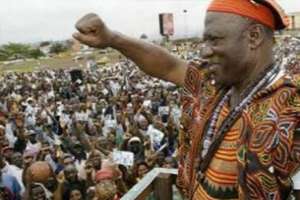
I remember Saturday the 26th of May 1990 as if it was yesterday. I was among the thousands of people who gathered round a decrepit Toyota Hiace bus to hear Ni John Fru Ndi launch the Social Democratic Front (SDF). Standing on either side of him were Bosco (a furniture maker at Progressive Modern Furniture) and Prof Siga Asanga (the new party’s scribe and chief ideologue).
I had left my house that afternoon, together with Anafor Gabriel Agbor knowing full well that I may not come back to it alive. The military build-up in Bamenda town, prior to, and on the 26th of May itself, was such that any one venturing out knew for a fact they stood a high risk of being shot dead by security forces bent on making sure the launch of the SDF never happened.
But it did. Bamenda had “chopped fire”.
As I marched alongside Prof Asanga from Ntarinkon Park through Longla Street to City Chemist Roundabout, I could see grown men shedding tears of joy. “We did it, we did it!” was echoed all around me. I saw pride in their faces.
In risking our lives to go out, Anafor Gabriel Agbor and I had come to the conclusion that, either way, history was going to be made that day and we needed to be eyewitnesses to it. A big brother, Tam Moise, who was sick and couldn’t join the march had stopped by, as if sent by God, prayed for us and sent us forth. And it worked. We witnessed history and lived to tell it.
That is the history I celebrate today. I celebrate the resilience of a city and the courage of a people who braved guns and bullets to launch a political party and re-usher into a battered nation, multiparty politics and the dream of a just and democratic society founded on “people power” and the rule of law.
Cameroonians from North to South and from East to West shared in and identified with this redeeming message of the SDF. The SDF made Cameroonians dream in a way no political party before it had been able to do.
Unfortunately thirty years down the line, the party that once incarnated the hope, and earned the trust of millions has turned out to be an unmitigated disaster. It has been unable to deliver on its promise of change and of a revolutionary transformation of the Cameroonian society.
It is now obvious that the SDF never had a long-term political plan or vision on how to conquer power. A combination of arrogant leadership, inconsistent strategies and dubious political alliances has been the party’s undoing.
But above all else we must also be honest and brave to say it was the SDF that brought the politics of hatred and violence to Anglophone Cameroon. During the 18 years of autonomous politics (1954 -1972) in British Southern Cameroons/Southern Cameroons/West Cameroon, politics was largely a gentleman’s game. I have read most of the political literature and history of Southern/West Cameroon and I have found no instance of politically-motivated violence, especially assassinations and burning of private property. That doesn’t mean that our forebears did not play dirty politics; their dirty politics never degenerated into killings and the destruction of the property of opponents.
To this day I still cannot fathom why SDF militants unleashed a hitherto unknown and an unprecedented level of violence against the NW CPDM elite after the proclamation of the 1992 presidential election results. The SDF won that election in the NW by more than 90%. None of those whose property was burnt had anything to do with the final results that were proclaimed in faraway Yaoundé. Yet they are the ones who were targeted by SDF militants.
And in that instant the seeds of the politics of hatred and the use of violence for political ends had been planted in Anglophone Cameroon.
The seed that was planted in 1992 is now bearing fruit in abundance in 2020 – the fascist approach to politics.
As I look back at the SDF, I am at a loss to say what really it is at 30: is it a hardworking horse that worked itself to its own eternal death or a sleeping tiger that shall wake up to roar again?
I leave that to my friends, Dr Eugene Shey Tata Ateh and Taanu Nana Bi Bura to answer.
Disclaimer: I have never been a militant of the SDF or of any political party, for that matter.
Timid celebrations mark SDF’s 30th anniversary
The Social Democratic Front, SDF, clocked thirty on Tuesday, May 26 but the celebrations were far from what used to obtain in previous years.
For such a milestone, party authorities decided to keep the celebrations low-keyed first of all due to the COVID-19 pandemic which has forced the government to restrict gatherings.
The party’s Chairman Ni John Fru Ndi has been out of the country for medical treatment even before the outbreak of the COVID-19.
In his absence, celebrations have been timid especially in the party’s stronghold in the North West Region which has been rocked by violence since 2016.
Other party bigwigs, for their part, decided to use the day as a moment of reflection on the road covered so far in the fight for democracy in Cameroon.
After 30 years, the party’s influence has dwindled and they have lost influence in parliament where they count only five seats. Party bigwigs blame the situation on the crisis in the North West and South West regions that has weakened its base but say they are now strategising to revamp the party.