A PHP Error was encountered
Severity: Warning
Message: Undefined array key 0
Filename: views/newspaper.php
Line Number: 25
Backtrace:
File: /home1/checkam/news.checkam.info/application/views/newspaper.php
Line: 25
Function: _error_handler
File: /home1/checkam/news.checkam.info/application/controllers/Newspaper.php
Line: 614
Function: view
File: /home1/checkam/news.checkam.info/index.php
Line: 315
Function: require_once
A PHP Error was encountered
Severity: Warning
Message: Attempt to read property "name" on null
Filename: views/newspaper.php
Line Number: 25
Backtrace:
File: /home1/checkam/news.checkam.info/application/views/newspaper.php
Line: 25
Function: _error_handler
File: /home1/checkam/news.checkam.info/application/controllers/Newspaper.php
Line: 614
Function: view
File: /home1/checkam/news.checkam.info/index.php
Line: 315
Function: require_once
A PHP Error was encountered
Severity: Warning
Message: Undefined array key 0
Filename: views/newspaper.php
Line Number: 25
Backtrace:
File: /home1/checkam/news.checkam.info/application/views/newspaper.php
Line: 25
Function: _error_handler
File: /home1/checkam/news.checkam.info/application/controllers/Newspaper.php
Line: 614
Function: view
File: /home1/checkam/news.checkam.info/index.php
Line: 315
Function: require_once
A PHP Error was encountered
Severity: Warning
Message: Attempt to read property "name" on null
Filename: views/newspaper.php
Line Number: 25
Backtrace:
File: /home1/checkam/news.checkam.info/application/views/newspaper.php
Line: 25
Function: _error_handler
File: /home1/checkam/news.checkam.info/application/controllers/Newspaper.php
Line: 614
Function: view
File: /home1/checkam/news.checkam.info/index.php
Line: 315
Function: require_once
Kumba massacre: Victims’ parents curse as gov’t and separatists play hardball!
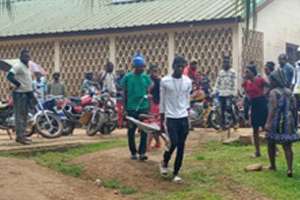
Kumba massacre: Victims’ parents curse as gov’t and separatists play hardball!
The conflict in the Anglophone regions of Cameroon is now deadlocked. There is no dialogue between Yaounde and the separatists, who are both refusing to give ground: the government is counting on a military victory and refuses to discuss the form of the state; the separatists demand independence. In this deadlock, civilians are paying a heavy price with their lives.
By Akua Nalova Mambeh
There is no sacred music; no hymns; no worship songs—none of the absorbing symphonies you might expect in a typical Church service on any Sunday at the World Restoration Ministry International Fiango, Kumba in the restive South West Region of Cameroon. The church is filled with worshippers, but empty of the soul of the producer of these symphonies-- Victory Ngamenyi. The 11-year-old was among the seven students killed when unidentified gunmen stormed the Mother Francisca International Bilingual Academy, a private school in Kumba, on Saturday, October 24, 2020. Thirteen other students were wounded, eight of them severely, according to government sources.
The unarmed, innocent children were caught in the crossfire of the Anglophone conflict pitting the Cameroon government forces and Anglophone armed separatists demanding independence from Francophone-dominated, centralized Cameroon. No one has claimed responsibility for the attack but the Cameroon government has blamed the separatist fighters—an accusation quickly dismissed by the latter.
The seven students killed are the latest victims of a long-running but neglected conflict that has since killed more than 3,000 people, displaced over 700,000 others while around 800,000 children have been kept out of school.
The Tamungwa family was expecting their son to return safely from school as has been the case for the past two weeks, but instead received news of his death.
“I was in the house with my sick wife when a little girl came and started shouting, telling me they had shot and killed my son. I went to the school and saw my son dead. When I arrived, I realized that Victory was stabbed on his left chest. They (gunmen) were carrying knives, machetes and guns. Victory was among the three children who died on the spot,” said Pastor Boniface Tamungwa, father of the deceased Form One student and founder of the World Restoration Ministry International.
“Victory’s death is a great loss not only to me and my family, but to the body of Christ. This is a child who used to play the drums during church service in my Ministry. It is painful. The killers of my son should remember that no one will live here on earth forever. They will face the consequences of their actions. The act they have done to end the life of my son will affect their generations,” Tamungwa cursed.
“God revealed the incident that happened to my son to me two days earlier in a dream. I know who are responsible for the death of my son. I saw it but I never knew that it would come directly to my son,” the 48-year-old regretted.
For the mother the late Victory, the trauma is insurmountable.
“I am speechless. It is very painful to me. We loved him [Victory] so much. I went through a lot before conceiving Victory. I was tagged barren after eight years without any issue. God finally blessed me with Victory and his sister. But now…,’’ said 38-year-old CamaritaTamungwa, tears trickling down her cheeks.
As It Happened…
It is late Saturday morning, cold and grey. French revision classes are being dispensed to Form One students aged between nine and fifteen, eager to learn after a three-year curfew and shutdown of schools imposed by Anglophone secessionists. All of a sudden, a group of over ten unidentified men wielding guns and machetes, and dressed in civilian clothes, aboard motorbikes, storms the premises of the Mother Francisca International Bilingual Academy, a private school in the South West Region of Cameroon. They then open fire on the students. The casualty is heart-rending: seven deaths, among them a boy, and thirteen wounded, eight of them seriously.
As horrified parents enter the school minutes later, they are immediately confronted with the remains of a child who had received a brutalizing fatal head wound. The child is found face-down with a portion of her skull shattered by live bullets, while the brain matter lies centimetres away.
A woman runs into the scene, “Oh my God, who did this!” she asks no one in particular in plain English, amid an indiscernible chatter of local dialects.
As she moves to observe the rest of the scene, the enormity of the carnage becomes more revealing. Beside the child nearest the door, lies another little one. She, and the first child are facing each other, but in death. Their bodies lie buoyantly on the floor, as they died in great pain. Near them lies a pair of discarded shoes. The little girl’s hair trails in her blood and a textbook that has fallen perfectly open near her little head, broken by cruelty.
Next lies another victim. Her hands are curled about her head, in a pose that highlights her beauty, even in death. Beside her head can be seen pairs of shoes and papers, indicative of the children’s frantic attempts to flee the scene.
As parents and onlookers parade the school, the horrific scene becomes even more evident. The students who miraculously survived the attack are sitting in injury or horror reaching out for adults who flood the school, completely horrified by what they found.
In the hours that followed the incident, a wave of accusations and counter-accusations from the warring parties became deafening.
“This gruesome act was perpetrated by the armed separatist terrorists group,” said Rene Emmanuel Sadi, Cameroon’s Communication Minister.
“The government of the Republic, wishes to take once again the entire Cameroonian people as witness, and firmly denounces all these fellow citizens, who, lurking in the shadows abroad, in their host countries, mastermind these unspeakable assassinations and fuel the climate of insecurity in the North West and South West Regions,” he said.
But the office of the Ambazonia Governing Council, one of the groups fighting for the independence of the unrecognized Federal Republic of Ambazonia, quickly pushed back, saying it “is aware of Cameroon’s atrocious attempt to sabotage the smooth running of community Schools using the new curriculum designed by the Ambazonia Education Board,” and adding, “While we have sent our team to investigate, the Ambazonian Governing Council holds Cameroun responsible for such acts perpetrated on our people.”
Then came an outpour of global condemnation. Stephane Dujarric, spokesman for the United Nations Secretary General, Antonio Guterres, in a statement, described the attack as “a disturbing reminder of the heavy toll paid by civilians, including children, many of whom have been deprived of their right to education.”
UNICEF’s executive director, Henrietta Fore, in another statement said “attacks on education are a grave violation of children’s rights. Schools must be places of safety and learning, not deathtraps.” Then Cameroonians took the relay on the social media as the hashtag EndAnglophoneCrisis flooded these platforms. A day of national mourning was set aside for the victims of the incident a week later (Saturday 31st October 2020).
How It Got To This
Cameroon has a multilayered colonial history. It was first colonized by Germany in 1884, and then divided between the French and the British colonial forces in 1919. French Cameroon gained independence in 1960, joined by English-speaking Cameroonians through a federation a year later, after a UN-organized plebiscite. In 1972, the original federal structure that post-colonial unification was based on was abrogated following an organization of an unconstitutional referendum. Anglophone Cameroonians who make up 20 percent of the country’s 25 million people have long complained that the termination of the federal structure in favor of a unitary state, fueled the marginalization of their language and culture.
Violence has torn through the Anglophone regions of Cameroon for four years now. It began when Common Law Lawyers and Anglophone teachers downed their tools in late 2016 in a peaceful protest to resist what they termed, a deliberate attempt by the central government to wipe out two core cultural values of the Anglophone community in Cameroon, namely, the Common Law and the Anglo-Saxon Sub-System of Education.
But the Yaounde regime, led by President Paul Biya, 87, in power for 38 years, misunderstood the peaceful demonstration as an act of rebellion that needed to be crushed with a military might.
“The conflict is the consequence of the lack of political will on the part of the government and her international partners to carry out a genuine and deep analysis of the conflict in order to understand its intricacies so as to be able to adapt interventions that respond to its deep-seated historical and structural causes,” said Dr William Hermann Arrey, senior lecturer and Chair of Department of Peace and Development Studies at the Protestant University of Central Africa.
“The intricacies in the conflict are circumscribed around the conflicting and apparently irreconcilable interests of the different actors and protagonists as well as the dynamics of wartime economy that has led to the commercialization for economic gains by wartime entrepreneurs on both sides,” he said.
The school-going children’s October 24 killing, coming less than two months after another civilian, Comfort Timasam, a 32-year-old mother of two, was killed by suspected separatists is a painful reminder of similar gruesome killings in the escalating Anglophone conflict in Cameroon most remarkably that of women and children. There has been a litany of similar gruesome killings committed both by the secessionist forces and the Cameroon military. A 2020 report by the Centre for Human Rights and Democracy in Africa, an independent non-governmental organization, has uncovered numerous cases of “atrocities committed against civilians by armed separatist fighters.”
Last April 21, Cameroon acknowledged the army’s role in the killing of at least 13 civilians- including children and women in the country’s North West Region amid the raging conflict after initially denying responsibility for the killings.
The secessionist forces who picked up arms against the state claiming to defend the Anglophone community number between 2,000 and 4,000 armed fighters- splintered into two rival so-called Ambazonia interim governments. One is led by Sisiku Julius Ayuk Tabe, the self-proclaimed President of the state which the revolution seeks to create called “Ambazonia”. He is currently serving a life sentence on terrorism and secession charges in the Kondengui Prison in Cameroon. The other group is headed by Samuel Ikome Sako, a US-based former pastor, and the interim president of the unrecognized Federal Republic of Ambazonia. The split in the movement followed the arrest of Sisiku in Nigeria, along with nine other senior officials on their extradition to Cameroon.
Many in Cameroon hold that the purpose of a conflict initially meant to restore Cameroon’s former federal structure has been defeated.
“The conflict has gone out of control. Nobody foresaw that there will be burning of villages, killing of people; that people will be arrested and massively put in jail; that some will go on exile,” said Nkongho Felix Agbor, President of the Centre for Human Rights and Democracy in Africa and one of the lawyers who initiated the peaceful protests that escalated to the present conflict.
“There is a need for both parties in the conflict to think more about the people and try to find a long-lasting solution that will be a win-win for everybody. We are gone beyond the blame game. We should now collectively look for a solution because at the end of the day, everybody is suffering whether you are in the separatist camp or in the government camp. The country is bleeding,” he said.
Observers attribute the escalation of the conflict to government’s intransigence to organize an inclusive dialogue.
“Government should grant amnesty to all those arrested in relation to the crisis including the leaders of Anglophone armed groups so genuine talks, with the facilitation of a trusted mediation could start,” said Dr Arrey of the Protestant University of Central Africa.
“This conflict can be brought to a definitive end by suspending all military operations and ceasing the targeting of civilians by both state security forces and separatist groups. The Anglophone non-state armed groups should participate with good will in the genuine dialogue should government launch it.”
The conflict in the Anglophone regions of Cameroon is now deadlocked. The intransigence of the belligerents threatens to generate further violence and prolong the conflict, which neither can win in the short term. The separatists continue to dream that independence is just around the corner. In Yaounde, the government still wrongly believes it can win a quick military victory. To break the deadlock, Cameroonian and international actors should put pressure on the government and the separatists. Both sides must explore compromise solutions aimed at a level of regional autonomy somewhere between the secession desired by the separatists and the fake decentralization proposed by Yaounde.